
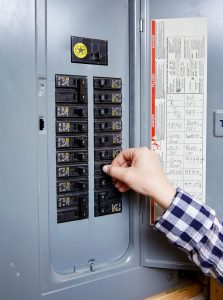
Your electrical service panel serves as the central engine of your home’s electrical distribution system. Every watt of power delivered from the municipal grid flows directly into this enclosure, where individual circuit breakers distribute electricity to your kitchen appliances, lighting, HVAC systems, and electronics.
In established neighborhoods across the Denver Metro Area including older homes throughout Lakewood, Littleton, Arvada, Wheat Ridge, Aurora, and Centennial, thousands of homes still operate on 60-amp or 100-amp electrical panels installed decades ago. While these systems were sufficient for basic mid-century appliances, they were never engineered to support the demanding power requirements of modern living.
From Level 2 Electric Vehicle (EV) home chargers and high-efficiency heat pumps to central air conditioning units, hot tubs, and modern kitchen suites, today’s Colorado homeowners demand more power than ever before. When an electrical panel is pushed beyond its safe design limits, it exhibits clear warning signs.
This guide explores the top seven signs that your electrical panel requires an upgrade, details the safety risks of ignoring an overloaded system, and explains the step-by-step process of transitioning to a modern 200-amp service.
When Should You Upgrade?
- The Problem: Older 60A and 100A panels struggle with modern electrical loads, leading to circuit overloads, thermal stress, and power instability.
- The Warning Signs: Frequent breaker tripping, flickering lights, strange buzzing sounds, warm panel covers, and obsolete panel brands (FPE, Zinsco, Challenger).
- The Modern Standard: A 200-amp main breaker panel equipped with Arc-Fault (AFCI) and Ground-Fault (GFCI) protection, dedicated branch circuits, and whole-home surge suppression.
- The Benefit: Safe, reliable power for EV charging, HVAC electrification, renewed home insurance eligibility, and increased home value across the Denver market.
Sign #1: Frequent Breaker Tripping
A circuit breaker is designed to trip (shut off power) when the electrical current running through a wire exceeds its safe amperage rating.
- Occasional Tripping: If a breaker trips once when you run a space heater and a hairdryer simultaneously on the same bathroom circuit, the breaker is performing its job correctly by preventing the branch wiring from overheating.
- Persistent Nuisance Tripping: If you find yourself resetting breakers weekly, or if a breaker trips under routine daily use, it indicates that the branch circuit is fundamentally overloaded.
- Failing Breaker Mechanism: Over decades of service, the internal bimetal thermal mechanisms inside breakers weaken from repeated heat cycles. When breakers wear out, they begin tripping prematurely under normal, low-amp loads.
Sign #2: Flickering or Dimming Lights Under Heavy Load
If the overhead lights in your living room or kitchen briefly dim or flicker every time your central air conditioner compressor starts up, your microwave runs, or your refrigerator cycles on, your electrical system is struggling with voltage drops.
- Inrush Current Demands: High-power appliances with large inductive motors require a brief burst of high startup current (inrush current).
- Undersized Main Service: If your main service panel is rated at 100 amps or less, there is insufficient overhead capacity to handle these momentary current spikes without pulling voltage away from your standard 120-volt lighting circuits.
- Loose Neutral Connections: Flickering across multiple rooms simultaneously can also indicate a loose neutral conductor inside your electrical panel or service mast, which is a serious electrical safety hazard requiring immediate diagnostic inspection.
Sign #3: The Panel Is Rated at 60 or 100 Amps
Most homes built in Colorado between 1950 and 1980 were constructed with 60-amp fuse boxes or 100-amp circuit breaker panels. At the time, that was more than enough power to run a refrigerator, a few incandescent lamps, and a television.
Modern Colorado households operate in a completely different electrical landscape:
| Decade Built | Standard Service Size | Common Modern Household Needs |
| 1950s–1960s | 60 Amps (Fuses) | Basic lighting, radio, early TV |
| 1970s–1980s | 100 Amps (Breakers) | Central heating, electric range, dishwasher |
| Today (Modern Standard) | 200 Amps | EV Chargers (40A–50A), Central AC / Heat Pumps (30A–50A), Induction Cooktops, Hot Tubs, Smart Electronics |
If your electrical panel is rated at 100 amps or less, it lacks the physical capacity and bus bar amperage to support modern home additions safely. Upgrading to a 200-amp service is the gold standard for residential properties.
Sign #4: Obsolete or Hazardous Panel Brands (FPE, Zinsco, Challenger)
If your electrical panel bears the name Federal Pacific Electric (FPE), Stab-Lok, Zinsco, GTE-Sylvania, or Challenger, replacement is an urgent safety necessity regardless of whether you are experiencing electrical issues.
- Federal Pacific (FPE) Stab-Lok: Documented failure rates show that FPE breakers fail to trip in 1 out of 4 overload events, allowing dangerous overcurrent to overheat home wiring.
- Zinsco / Sylvania: Aluminum bus bars oxidize, creating high electrical resistance that melts breaker casings directly to the bus bar.
- Challenger: Certain Challenger 15-amp and 20-amp single-pole breakers manufactured in the 1980s and 1990s are prone to overheating at the bus bar connection, creating mechanical arcing.
- Insurance Implications: Many Colorado homeowners insurance underwriters refuse to issue or renew coverage on homes equipped with these obsolete panels until they are replaced by a licensed electrical contractor.

Sign #5: Scorch Marks, Burning Smells, or Sizzling Sounds
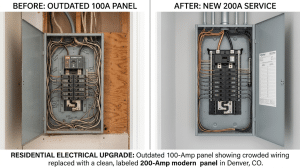
Any direct physical or sensory indicator of distress from your electrical panel demands immediate professional evaluation:
- Burning Plastic or Ozone Odors: A distinct fishy, plastic, or chemical burning smell originating from the panel enclosure indicates that wire insulation or breaker casings are melting due to excessive heat.
- Visible Scorch Marks or Soot: Blackened metal, discolored plastic breaker casings, or melted wire jackets inside the enclosure are proof of past or active electrical arcing.
- Buzzing, Humming, or Hissing Sounds: Electrical current should flow silently. A distinct buzzing or crackling noise means current is jumping microscopic gaps between loose terminal screws or vibrating against worn breaker contacts.
- Warm Panel Enclosure: The metal door of your panel should always feel cool to the touch. If the deadfront cover or breaker handles feel warm or hot, the system is experiencing high electrical resistance.
Emergency Action: If you see active smoke, sparks, or intense heat originating from your electrical panel, evacuate the immediate area and call emergency services and your utility provider immediately.
Sign #6: Overuse of Power Strips, Extension Cords, or “Tandem” Breakers
Look at your home’s electrical layout and the panel interior:
- Octopus Plugs and Extension Cords: If your home requires a web of multi-plug adapters and extension cords in every room, your electrical infrastructure lacks the branch circuit capacity to meet your daily needs safely. Extension cords are temporary solutions, not permanent wiring.
- Overcrowded “Tandem” Breakers: When older panels run out of physical space, electricians or previous DIY homeowners often install slim “cheater” or tandem breakers to squeeze two circuits into one slot. When a panel is maxed out with tandem breakers, the interior bus bar is subjected to thermal stress exceeding its engineered rating.
Sign #7: Adding Major High-Draw Electrification Upgrades
Are you planning home improvements or modernizing your property in Denver? Major lifestyle and efficiency upgrades require substantial dedicated electrical capacity:
- Level 2 Electric Vehicle (EV) Chargers: Dedicated 240-volt circuits pulling 32 to 50 continuous amps.
- Heat Pumps & High-Efficiency Central AC: Modern HVAC conversions require 30 to 50 amps of stable power.
- Finished Basements & Additions: New living spaces, guest suites, and home offices require multiple dedicated 15A and 20A branch circuits.
- Outdoor Living Upgrades: Hot tubs, swim spas, and high-wattage patio heaters demand heavy 240V dedicated lines.
Attempting to add these high-draw systems to an aging 100-amp service panel without an upgrade can cause continuous main breaker tripping and violate local electrical codes.
Here is a look at an electrical panel upgrade completed by the Eastman Electric team for a residential homeowner in Denver, Colorado:
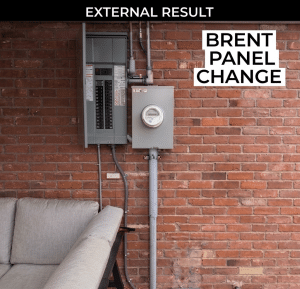
- Initial Assessment: The homeowner purchased a new electric vehicle and wanted to install a Level 2 home charger. An inspection revealed an original 1978 100-amp service panel that was completely maxed out, showing heat discoloration on two main breaker lugs and zero space for a 240V double-pole breaker.
- The Eastman Solution: We acquired city permits, coordinated with Xcel Energy for utility disconnect, removed the obsolete panel, and installed a modern 200-amp service panel complete with dual-function AFCI/GFCI breakers, whole-home surge protection, and a dedicated 50-amp EV charging circuit.
- The Result: The home passed municipal electrical inspection on the first visit, the homeowner charges their vehicle safely overnight, and the electrical infrastructure is prepared for future solar or heat pump additions.
Frequently Asked Questions (FAQs)
How much does an electrical panel upgrade cost in the Denver Metro Area? The cost of an electrical panel upgrade depends on several factors: upgrading from 100A to 200A versus 400A, whether the exterior utility meter socket and service mast need replacement, and the amount of branch circuit rewiring required. Eastman Electric provides upfront, transparent on-site estimates before any work begins.
How long does a panel upgrade take? A standard residential panel upgrade typically takes our licensed electrical crew between 6 to 8 hours to complete. Power is safely disconnected in the morning with your utility provider and restored by late afternoon once city inspection coordination is finalized.
Do I need a city or county permit for a panel replacement in Colorado? Yes. All service panel upgrades require a municipal electrical permit and a formal inspection by the local building department (such as the City of Denver, Jefferson County, or Arapahoe County). Eastman Electric manages the entire permitting and inspection process from start to finish.
What is the difference between a 100-amp and a 200-amp panel? A 200-amp panel provides double the electrical throughput capacity of a 100-amp panel, uses heavier incoming feeder conductors, features larger copper bus bars, and offers significantly more physical breaker slots to safely distribute power across modern household circuits.
Upgrade Your Electrical Capacity with Eastman Electric
Don’t wait for an overloaded panel to cause power interruptions or electrical fire hazards. Eastman Electric delivers transparent, high-quality, and code-compliant electrical panel upgrades across the Denver Metro Area, Colorado Front Range, and surrounding mountain communities.
Contact us today to schedule your comprehensive on-site electrical evaluation and panel upgrade estimate.
- Phone: (720) 536-0300
- Email: [email protected]
- Website: CallEastman.com